We take part in the Amazon Associates programme. When you buy through a link on this page, we may earn a commission — your price stays the same.
Finding the right GPS dog tracker depends on your location and walking habits. Some owners need a worldwide connection for roaming pets, while others prefer off-grid tools for hiking. The main choices are between trackers requiring a subscription for live tracking or those that work without phone signals. For global coverage, consider the Tractive Smart GPS Tracker; for subscription-free outdoor adventures, the Aorkuler Outdoor GPS Tracker is a standard choice.
1. Tractive Smart Dog GPS Tracker

Best for: Owners wanting global, real-time location and health monitoring.
This tracker provides live updates every few seconds, which is vital if your dog is quick to bolt. It uses a cellular connection to give you an unlimited range, meaning you can see your pet’s location from anywhere as long as there’s mobile coverage. The device also monitors heart and respiratory rates, helping you spot changes in your dog’s health early.
Because it relies on cellular networks, this tracker isn’t for people who spend most of their time in deep wilderness where there’s no signal. It requires a subscription to keep the SIM card active, which is an ongoing commitment. It’s designed for dogs over 8 pounds and is fully waterproof for all-weather use.
Good if:
- You want unlimited range anywhere with cell service.
- You need detailed health and barking alerts.
- You want to set up virtual fences for home or parks.
Skip it if:
- You refuse to pay monthly subscription fees.
- You only walk your dog in remote areas with no phone signal.
2. Dogtra PATHFINDER2 MINI Compass Live GPS Dog Tracking & Training

Best for: Professional training and tracking multiple dogs in the field.
This system is built for serious training, featuring a handheld device that works independently of your phone. It offers a 4-mile range and allows you to control e-collar functions like tone or vibration directly from the remote. The bright 2-inch screen shows you exactly where your dog is, along with speed and distance data.
This is a heavy-duty tool designed for users who need total control over their dog’s behavior. It isn’t for the casual walker who just wants to check in on a pet’s location. The system is expandable, meaning you can track up to 21 dogs if you have a large pack.
Good if:
- You need e-collar training features built into the tracker.
- You prefer a handheld device over using a smartphone app.
- You’re tracking multiple dogs at once.
Skip it if:
- You only need simple tracking without training functions.
- You’re looking for a lightweight, unobtrusive collar attachment.
3. Aorkuler Outdoor GPS Dog Tracker
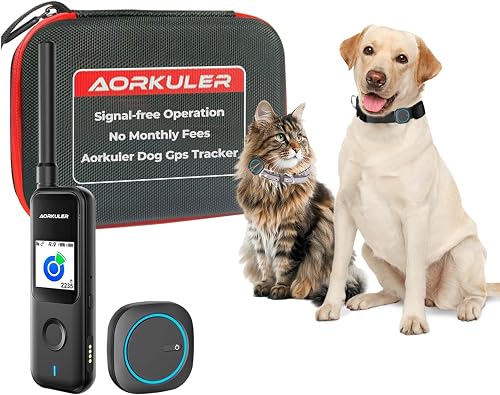
Best for: Stress-free, off-grid tracking during rural hikes.
This device is designed for simplicity, showing you the direction and distance to your dog on a small controller. It requires no apps, no cellular signal, and no subscriptions, making it a straightforward choice for remote areas. It’s lightweight at just over an ounce, so it stays comfortable on your dog during long walks.
This tool isn’t for owners who want to track their dog from their office or home while the pet is in the yard. It’s strictly a short-range, direct-line tool for outdoor adventures. You’ll need to charge it after 24 hours of continuous use.
Good if:
- You want a simple “point-and-go” system without apps.
- You hike in areas with no cellular coverage.
- You want to avoid monthly fees.
Skip it if:
- You want to track your pet from long distances.
- You prefer seeing your dog’s location on a satellite map.
4. Life360 Pet GPS Tracker

Best for: Households already using the Life360 network.
This tracker integrates with a massive community network to help find lost pets. It provides live location updates and customizable virtual fences, sending alerts to your phone if your dog leaves a safe zone. The battery is designed for long life, and it includes a reserve mode to keep the tracker active for months after the main charge runs out.
You must have cellular coverage for this device to send location data to your phone. It requires a subscription after the included first year, so factor that into your long-term plans. It’s best suited for those who are already comfortable with the Life360 ecosystem.
Good if:
- You want to tap into a large community for lost pet support.
- You need long battery life with a backup reserve mode.
- You want activity monitoring and care reminders.
Skip it if:
- You don’t want to manage a subscription service.
- You live in an area with poor cellular service.
5. Tractive XL Smart Dog GPS Tracker
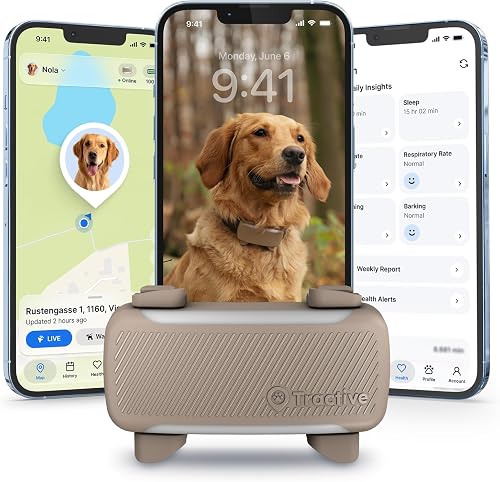
Best for: Large dogs that need a sturdy, long-lasting tracker.
This is the larger version of the Tractive system, built specifically for dogs over 44 pounds. It offers the same live tracking and health monitoring as the smaller model but with a battery that can last up to 6 weeks. It’s a robust option for owners who don’t want to worry about charging the device as often.
Like the standard model, this requires a subscription to operate its cellular features. It isn’t suitable for smaller breeds due to its size and weight. It’s best for owners who prioritise battery endurance and health insights for their larger companions.
Good if:
- You have a large dog and want a longer battery life.
- You want active health and respiratory monitoring.
- You need unlimited range via cellular networks.
Skip it if:
- You have a small dog under 44 pounds.
- You’re looking for a device that doesn’t require a subscription.
6. Dogtra GPS Fence

Best for: Setting up reliable, virtual boundaries without wires.
This system creates a wireless fence that keeps your dog within a specific area. It uses tone, vibration, and stimulation to guide your dog back if they reach the boundary. Once you set it up with the app, the collar works independently, so you don’t need to keep your phone connected.
This is a containment system, not a live GPS tracker for when your dog is out on a walk. It isn’t for people who want to see their dog’s path on a map. It’s designed for properties larger than 3/4 of an acre.
Good if:
- You want to contain your dog without digging trenches for wires.
- You want a system that works independently after initial setup.
- You want multiple levels of boundary alerts.
Skip it if:
- You want to track your dog’s live movements on a map.
- You have a very small property or live in an apartment.
7. eMACROS Dog GPS Tracker No Subscription
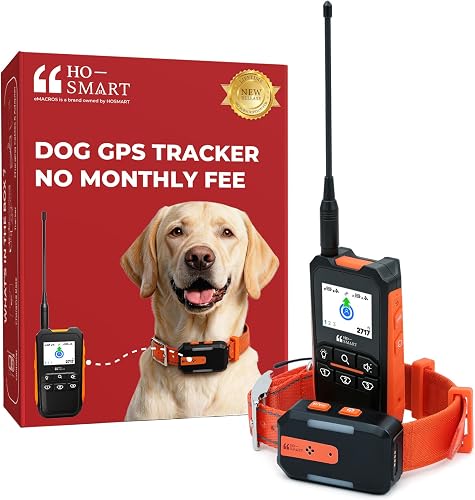
Best for: Long-range tracking in rural or forested areas.
This radio-frequency tracker works without any cellular signal or internet. It provides a handheld controller that shows a simple arrow and distance to your dog. It’s rugged and waterproof, making it a solid choice for dogs that enjoy swimming or mud.
The range varies significantly based on the terrain. You’ll get up to 3 miles in open seaside conditions, 2 miles in rural areas, and 0.5 miles in forested areas. Dense bushes and terrain may slow signal acquisition, so expect lower performance in thick brush. It isn’t for people who want to track their dog from a different city or state. The system is designed for dogs 35 pounds and up.
Good if:
- You need a system that works in deep woods or rural areas.
- You prefer simple distance and direction arrows over maps.
- You need a 3-level virtual fence to alert you if your dog strays.
Skip it if:
- You need to track your pet from a long distance.
- You have a small dog under 35 pounds.
- You require satellite-based map views to locate your pet.
8. DBDD GPS Dog Tracker with Subscription
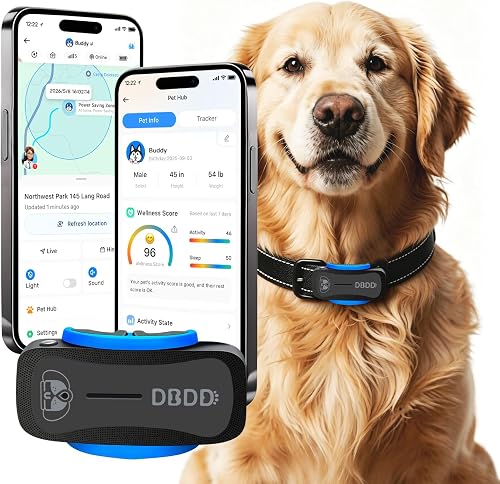
Best for: Owners focused on AI-driven health insights.
This tracker combines real-time location tracking with an AI wellness assistant. It monitors your dog’s activity and rest patterns, offering goals to keep them healthy. It sets up quickly by scanning a QR code.
The device requires a subscription plan to unlock its full tracking features. It isn’t for users who want a simple, one-time purchase. The hardware is designed specifically for medium and large dogs weighing 30lbs or more. If your dog is smaller, this device won’t provide accurate health data.
Good if:
- You want professional health insights and activity tracking.
- You want real-time location history on your phone.
Skip it if:
- You have a small breed dog.
- You need a device that functions without an active data plan.
The IP67 rating ensures the tracker remains functional during outdoor exploration, making it a robust choice for active, larger pets.
9. GPS Tracker for 2 Dogs
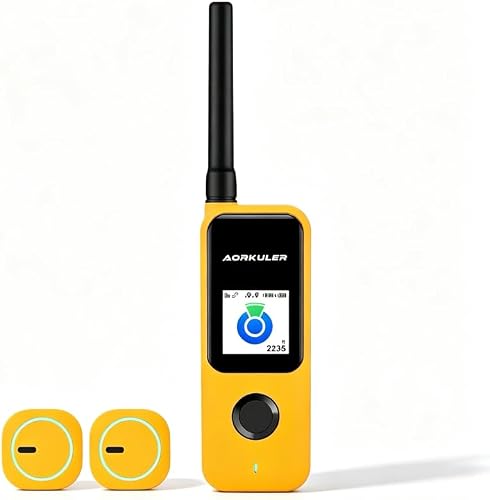
Best for: Owners with two dogs who want off-grid tracking.
This multi-dog system lets you keep track of a pair of pets using a single handheld controller. It uses radio frequency, so you don’t need apps or cellular signals. Each lightweight tracker weighs just 1.08 oz, making it a practical choice for outdoor exploration.
It doesn’t provide maps; you only get a direction and distance indicator on the controller. Follow the green arrow to locate your pets. It isn’t for people who want to see their dog’s exact location on a satellite view. The battery life lasts up to 24 hours, though this varies based on usage. It’s best suited for typical 1–2 hour daily walks.
Good if:
- You need to monitor a pair of pets simultaneously.
- You hike in areas with no phone service.
- You want a simple system with no subscription fees.
Skip it if:
- You need precise map-based tracking.
- You want to track your dog over very long distances.
To manage multiple pets, simply press the center button on the controller to toggle between them. If you register your product, you can extend the standard 1-year limited warranty to 3 years.
10. Ultra-Slim GPS Tracker
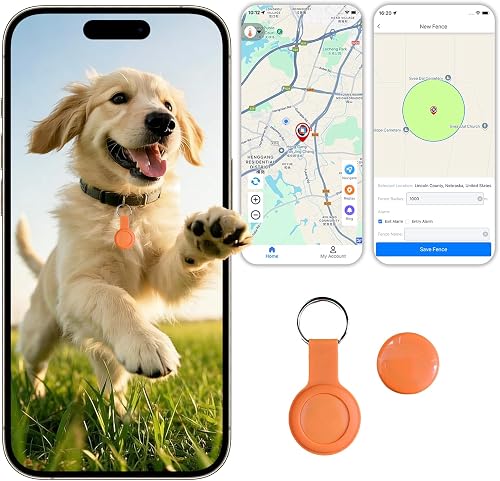
Best for: Owners wanting a lightweight, low-maintenance design.
This ultra-slim tracker utilises a replaceable battery designed to last up to 365 days. Its IPX7 waterproof rating ensures durability during outdoor play, while the included silicone case and metal ring allow for secure attachment to any collar, leash, or bag. You can manage the device through a free app.
The system operates without a SIM card. However, this isn’t a live, second-by-second tracker. The GPS provides location updates approximately every minute under normal conditions. If you need to monitor an active escape artist, this delay may be insufficient. Use this device to review movement history or share location data with family members.
Good if:
- You want a lightweight device without recurring subscription charges.
- You prefer a battery that requires replacement only once a year.
- You need to share location data with trusted contacts.
Skip it if:
- You require instant, real-time tracking for an animal prone to bolting.
- You expect advanced features like integrated health monitoring.
Where These Overlap
Most trackers fall into two distinct camps: those relying on cellular networks and those using radio frequency. Cellular options, such as Tractive or Life360, are superior for urban or suburban users wanting to check on their dog from anywhere. If you live in a city, the choice often hinges on the app interface and your preference between health monitoring or a community-based lost-pet network.
Radio-frequency systems, like Aorkuler or eMACROS, are built for the wilderness. They operate similarly, using a handheld controller with a directional arrow and requiring no monthly subscriptions. The primary difference is the effective range and the number of dogs you can monitor. When choosing between these, look closely at your specific range requirements in forested versus open areas. Terrain is the deciding factor in performance, as dense bushes, trees, and hills significantly reduce signal acquisition.
A common mistake is assuming these devices work identically regardless of environment. Cellular trackers fail in remote areas without signal, while radio-frequency trackers are limited by line-of-sight and physical obstacles. If you’re hiking in dense woods, the maximum signal range might effectively drop to a fraction of its potential. Always verify the weight requirements, as some units are designed for dogs 25 lbs or larger, while others are light enough for smaller pets.
Still Not Sure?
How often will I really use this?
If you only need a tracker for the occasional hiking trip, an off-grid radio-frequency system like the Aorkuler Outdoor GPS Tracker is likely enough. You won’t have to worry about monthly bills or signal dead zones when you’re deep in the woods. However, if you have a dog that tends to wander off at home, you need something that works 24/7. In that case, look at the Tractive Smart GPS Tracker for constant, reliable monitoring.
What do I already own that this has to work with?
Think about your current smartphone and your local cellular coverage. If you live in an area with poor signal, a cellular-based tracker like the Life360 Pet GPS Tracker will be frustrating to use. You should focus on radio-frequency systems like the Dogtra Pathfinder2 Mini, which operate independently of your phone’s signal. If you already have a strong signal and a smartphone you carry everywhere, the app-based trackers will provide a much more detailed map experience.
What am I most likely to regret choosing?
The most common regret is choosing a cellular tracker without realizing that a subscription is required. If you want to avoid monthly fees, never buy a model that requires a SIM card. Alternatively, users often regret buying a simple radio-frequency tracker when they actually wanted to see their dog on a map. If you’re the type who likes to see data, paths, and history on a screen, stick to the Tractive XL GPS Tracker or similar app-based systems.
Frequently Asked Questions
Does my dog need a specific collar for a GPS dog tracker?
Most trackers, like the Tractive Smart GPS Tracker, are designed to attach to your existing collar. You should check the weight and size of your dog against the manufacturer’s recommendations to ensure the device doesn’t cause discomfort. Always ensure the attachment is secure so the tracker doesn’t fall off during active play.
Can I use these trackers in the rain or while my dog swims?
Will these trackers work if I travel to another country?
Cellular-based trackers like the Tractive Smart GPS Tracker offer global tracking by using mobile networks. These devices work wherever there is compatible cellular service. Radio-frequency systems like the Aorkuler Outdoor GPS Tracker are limited to the range of the handheld controller, so they will not work if you travel far from your dog.
Do I need to charge the tracker every day?
Battery life varies significantly between models. Devices like the Ultra-Slim GPS Tracker use replaceable batteries that can last up to a year, while high-performance trackers like the Tractive XL GPS Tracker may last up to six weeks. Models that offer constant, real-time GPS updates, such as the Aorkuler Outdoor GPS Tracker, typically require charging every day or two.


1 thought on “10 Best GPS Dog Tracker Picks for Every Walking Style”